
Muscle-Sparing Subvastus Knee Replacement in Hampton Roads, VA
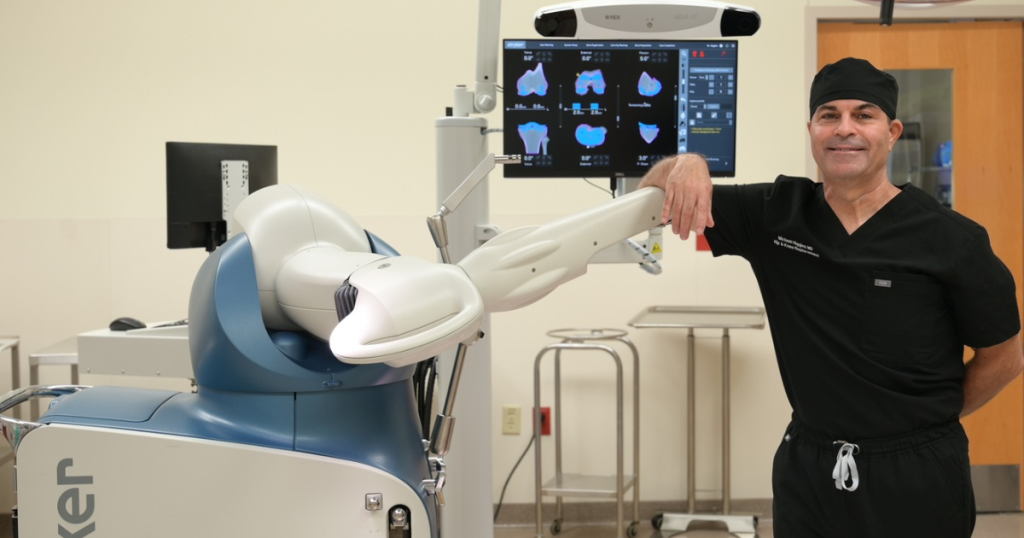
Dr. Michael E. Higgins is an experienced orthopedic surgeon who specializes in muscle-sparing knee replacement. He offers subvastus knee replacement, also called a quadriceps-sparing knee replacement, for patients in Hampton, Suffolk, Williamsburg, and Southeastern Virginia at Tidewater Orthopaedics.
What Is Muscle-Sparing Subvastus Knee Replacement?
Muscle-sparing subvastus knee replacement is a type of total knee replacement surgery that keeps muscles intact. Instead of cutting through the quadriceps tendon and muscle belly, the surgeon works beneath the vastus medialis muscle to reach the knee joint. This preserves the quadriceps and make the procedure a muscle-sparing option.
During surgery, the damaged surfaces of the knee are removed and replaced with artificial parts. This helps improve alignment and stability. Recovery depends on your health and the severity of your knee condition.
How Is It Different From Traditional Knee Replacement?
The traditional method of knee replacement utilizes the medial parapatellar approach. The knee joint is opened along and above the kneecap which involves cutting quadriceps tendon and muscle. With the subvastus approach the surgeon works beneath the vastus medialis preserving (not cutting) the quadriceps tendon and muscle.
Subvastus Muscle-Sparing Approach
Works beneath the vastus medialis
Preserves the quadriceps tendon
Less muscle disruption
Less weakness and pain enables some patients to regain function faster
Traditional Approach
Cuts the quadriceps tendon and muscle
Gives easier access to the knee joint
Has been used for many years
Dr. Higgins reviews each patient's needs to help choose the best approach.
Benefits of Muscle-Sparing Subvastus Knee Replacement
Possible benefits include:
Preservation of the quadriceps tendon
Less impact on the muscles that straighten the knee
Quicker return of knee function
Faster return to everyday activities
Research suggests that many of these benefits appear soon after surgery in the early recovery period. Long-term results can be similar to those of traditional knee replacement.
Who Can Have a Subvastus Knee Replacement?
Patients with knee arthritis, ongoing pain, and loss of function may be candidates for a subvastus total knee replacement when non-surgical care no longer helps. The evaluation often includes:
A talk about knee pain, mobility, and daily activity
A physical exam to check alignment and motion
Review of X-rays or other imaging
A look at medical history and surgery readiness
Some conditions may mean the subvastus approach is not the best fit. Dr. Higgins customizes the plan based on each patient's needs.
What Happens During the Surgery?
The steps in a muscle-sparing subvastus knee replacement often include:
Making an incision in the front or inner part of the knee.
Carefully reaching the joint while keeping the quadriceps tendon intact.
Removing damaged bone and cartilage.
Placing new knee replacement parts for stability.
Closing the incision carefully.
Starting early recovery with walking and physical therapy.
The incision size does not define a muscle-sparing procedure. How the muscles and tendons are handled matters more.
Recovery After Subvastus Knee Replacement
Recovery varies from person to person. Age, pre-surgery fitness, and home support can all affect healing.
Patients often aim to:
Stand, walk, and climb stairs a couple of hours after surgery
Control pain and swelling
Improve knee motion
Rebuild strength in the leg
Return to normal activities safely
Your medical team will give you personal recovery instructions.
Risks of Total Knee Replacement
As with all surgery, risks include infection, blood clots, and ongoing pain. Talk with Dr. Higgins about these risks before surgery.
Why Choose Dr. Michael E. Higgins?
Dr. Michael E. Higgins is a board-certified orthopedic surgeon with experience in hip and knee replacement, including complex cases. He has practiced at Tidewater Orthopaedics since 2006 and focuses on personal care.
If you are looking for a muscle-sparing knee surgeon in southeast Virginia, Dr. Higgins can help. Patients who need a knee replacement can see him at these offices:
Hampton: 901 Enterprise Parkway, Suite 900, Hampton, VA 23666
Suffolk: 7007 Harbour View Boulevard, Suite 108, Suffolk, VA 23435
Williamsburg: 4037 Ironbound Road, Williamsburg, VA 23188
Frequently Asked Questions
Is the subvastus approach truly muscle-sparing?
It is often called muscle-sparing because the surgeon works beneath the vastus medialis and keeps the quadriceps muscle and tendon intact, or does not cut these tissues. Surgery still involves an incision and handling of soft tissue, so 'muscle-sparing' does not mean there is no tissue trauma.
Is subvastus knee replacement the same as minimally invasive knee replacement?
The terms are sometimes used together, but they are not the same. Subvastus describes the path used to reach the knee. Minimally invasive may refer to incision size, tools, or methods meant to limit tissue disruption. A smaller incision alone does not define a subvastus approach.
Does muscle-sparing knee replacement mean a faster recovery?
Some studies show earlier quadriceps function, a sooner straight-leg raise, better knee motion, or improved mobility with the subvastus approach. These benefits are usually seen early in recovery, and not every patient has them. Long-term results may be similar to those of other established approaches.
Can surgeons use the subvastus approach for every knee replacement patient?
No. The safest approach depends on anatomy, stiffness, deformity, past surgery, scar tissue, the complexity of the replacement, and the surgeon's judgment. Dr. Higgins evaluates each patient one at a time. That said most patients needing a knee replacement are candidates.
Can surgeons use the subvastus approach with robotic-assisted knee replacement?
Yes, Dr. Higgins routinely utilizes the precision of robotic assisted knee replacement while employing a subvastus approach to the knee called the Ready Knee procedure. Combining the advantages of robotic assisted knee replacement and the subvastus approach allow patients to benefit from two advancements beyond a standard knee replacement. A surgical approach and robotic assistance do different jobs. The subvastus approach describes how the surgeon reaches the joint, while robotic technology optimizes precision in planning and implant placement. Using them together can give set patients up for success and potentially a faster early recovery.
How long does a knee replacement last?
Implant life varies based on age, activity, weight, implant type, alignment, health, and other factors. Dr. Higgins can review realistic expectations based on the patient's situation and current evidence.
Where does Dr. Higgins see knee replacement patients?
Dr. Higgins sees patients at Tidewater Orthopaedics in Hampton, Suffolk, and Williamsburg, Virginia, and serves communities across Hampton Roads and the Virginia Peninsula.
How can I determine if I'm a candidate?
If knee pain or stiffness makes walking, work, sleep, exercise, or daily activities harder, schedule an evaluation with Michael E. Higgins, M.D. at Tidewater Orthopaedics. Dr. Higgins will explain your diagnosis, review treatment options, and decide whether a muscle-sparing subvastus knee replacement may be right for you.
To learn more about Michael Higgins knee replacement care, contact Tidewater Orthopaedics at (757) 827-2480.